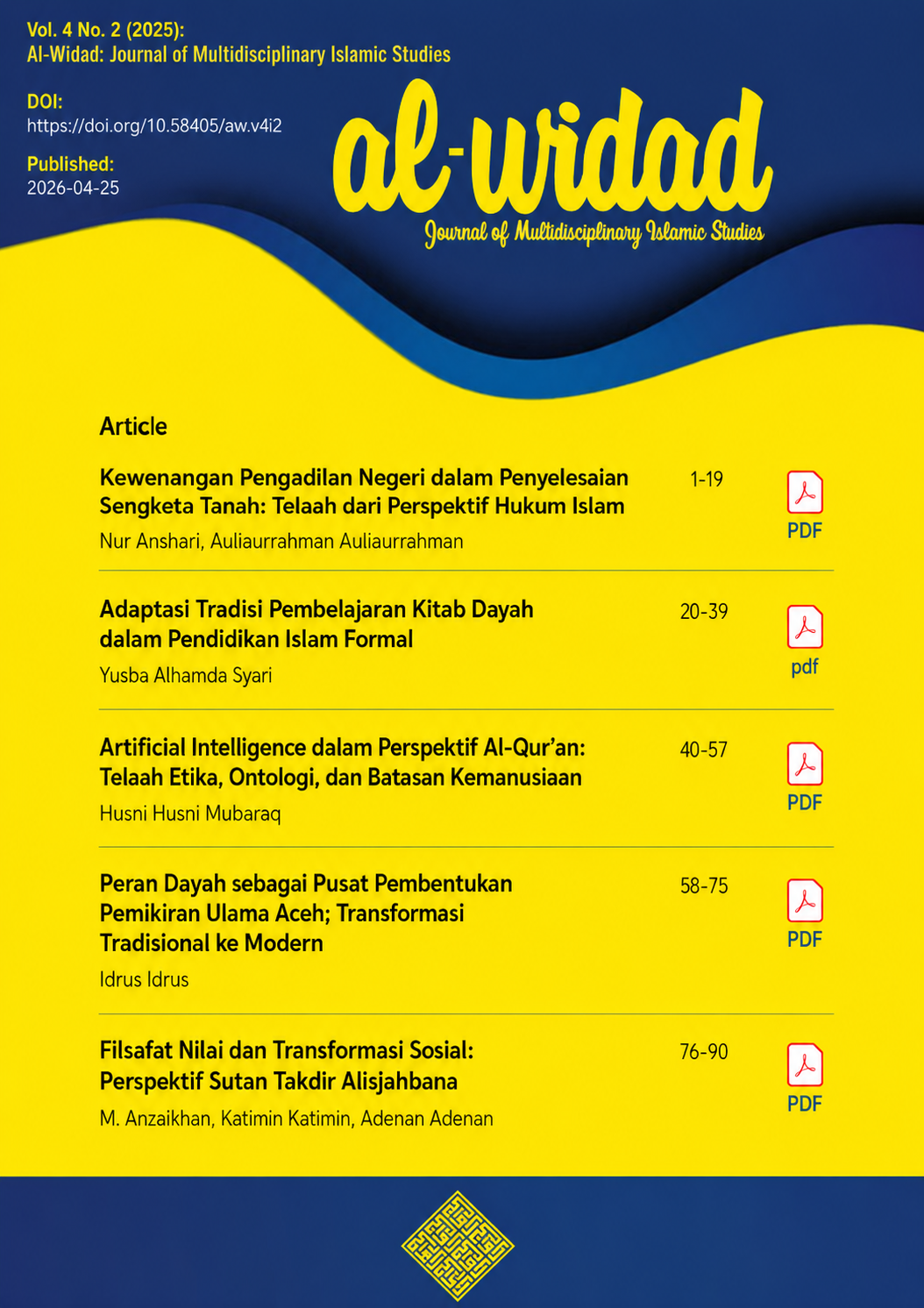
Adaptasi Tradisi Pembelajaran Kitab Dayah dalam Pendidikan Islam Formal
DOI:
https://doi.org/10.58405/aw.v4i2.85Keywords:
learning transformation, kitab tradition, religious practices, student identityAbstract
The transformation of kitab-based learning traditions from dayah into formal schooling raises a critical question regarding how deeply rooted religious values can be sustained within a structured and institutionalized educational system. This study seeks to examine how such transformation unfolds and how it shapes students’ religious practices and identity formation in Islamic primary education. Employing a qualitative approach with a case study design at SDIT Al-Marhamah Langsa, data were collected through observation, in-depth interviews, and documentation, and analyzed using the Miles and Huberman interactive model, with validation through data triangulation. The findings reveal that the transformation produces a hybrid learning model that integrates dayah traditions into formal schooling through methodological simplification, curricular alignment, and contextualization of values. This process contributes to more structured yet reflective religious practices among students and fosters an adaptive form of religious identity within their social environment. The study underscores that transformation does not diminish the essence of tradition but rather reconfigures it into a more contextual and meaningful form in students’ lived experiences.
Downloads
References
Bahri, S. (2015). Kajian Kitab di Dayah Salafiyah Rūḥ al-Fatā Aceh Besar: Tradisi dan Kontekstualisasi: Kitab Studies in Dayah Salafiyah Rūḥ al-Fatā Aceh Besar: Tradition and Contextualization. Penamas, 28(1), 121–136.
Erawadi, E., & Setiadi, F. M. (2024). Transformation of Traditional Islamic Education: Dayah as a Modern Educational Institution in Post-Conflict Aceh. FITRAH: Jurnal Kajian Ilmu-Ilmu Keislaman, 9(2), 225–246. https://doi.org/10.24952/fitrah.v9i2.10110
Fadila, F., Safriani, S., Eliana, E., & Khaddafi, M. (2025). Pengumpulan Data dalam Penelitian Kualitatif: Wawancara. Jurnal Intelek Insan Cendikia, 2(7), 13446–13449.
Fadlullah, A., & Mulyani, M. (2025). Membaca Kembali Realitas Sosial melalui Karl Marx: Refleksi Kritis atas Pendidikan dan Pengabdian Keagamaan. Tadabbur: Jurnal Peradaban Islam, 7(2), 115–126. https://doi.org/10.22373/tadabbur.v7i2.878
Faturahman, M., & Berakon, I. (2025). Local Indonesian Traditions and the Enhancement of Social Spirituality in Rural Communities. Penamas, 38(2), 153–167. https://doi.org/10.31330/penamas.v38i2.997
Gaikwad, M., Ahirrao, S., Kotecha, K., & Abraham, A. (2022). Multi-Ideology Multi-Class Extremism Classification Using Deep Learning Techniques. IEEE Access, 10, 104829–104843. https://doi.org/10.1109/ACCESS.2022.3205744
Husna, A., Mahfuds, Y., Uthman, Y. O. O.-O., & Aprilianto, A. (2023). Building A Muslim Worldview Through Islamic Education in The Middle of Globalization. Nazhruna: Jurnal Pendidikan Islam, 6(1), 46–59. https://doi.org/10.31538/nzh.v6i1.2622
Iswar, N. S., Suprapto, S., Khusniyah, N. L., & Thoib, I. (2025). Dynamics Dynamics of Islamic Education and Indigenous Culture in Lombok: A Historical Study of Adaptation, Acculturation, and Assimilation. FIKROTUNA: Jurnal Pendidikan Dan Manajemen Islam, 14(2), 123–133. https://doi.org/10.32806/jf.v14i2.927
Juliana, J., Ar, M., & Saiful, S. (2026). Modern Islamic Boarding Schools as Pillars of Contemporary Islamic Education: A Historical Review and Curriculum at Dayah. Tafkir: Interdisciplinary Journal of Islamic Education, 7(1), 47–62. https://doi.org/10.31538/tijie.v7i1.2364
Keiler, L. S. (2018). Teachers’ roles and identities in student-centered classrooms. International Journal of STEM Education, 5(1), 34. https://doi.org/10.1186/s40594-018-0131-6
Kusumajanti, K., Syarifuddin, S., Sanulita, H., & Gopur, G. (2025). Metodologi Penelitian Kualitatif: Teori dan Paradigma Baru Bidang Ilmu Sosial. PT. Sonpedia Publishing Indonesia.
Rahman, N. A., & Azzahra, A. (2024). The Role of Islamic Education in Preserving Cultural Identity Amidst Global Modernity. Sinergi International Journal of Islamic Studies, 2(4), 257–271. https://doi.org/10.61194/ijis.v2i4.707
Ridha, A. (2020). Reclassification of Traditional and Modern Dayah in Aceh from The Perspective of Systems Theory. Journal of Society Innovation and Development, 2(1), 39–49. https://doi.org/10.63924/jsid.v2i1.17
Salim, A. S., Suyuti, I., Prihantoro, W. K., Muqorrobin, A., & Nawangsasi, E. (2024). Integrating Javanese Culture in Islamic Education: The Role of Pathok Negara Mosque. Indonesian Journal of Islam and Muslim Societies, 14(2), 381–407. https://doi.org/10.18326/ijims.v14i2.381-407
Sumanti, S. T., Nunzairina, N., & Salminawati, S. (2024). The Evolution of Islamic Educational Institutions in North Sumatra Indonesia. Nazhruna: Jurnal Pendidikan Islam, 7(1), 1–19. https://doi.org/10.31538/nzh.v7i1.4419
Torres-Zaragoza, L. (2025). Moroccan Muslim Students’ Cultural and Religious Diversity Recognition in Spanish Schools: A Critical Multiculturalism Analysis from Their Mothers’ Perspectives. Frontiers in Education, 10. https://doi.org/10.3389/feduc.2025.1649446
Downloads
Published
How to Cite
Issue
Section
License
Copyright (c) 2026 Al-Widad

This work is licensed under a Creative Commons Attribution-ShareAlike 4.0 International License.