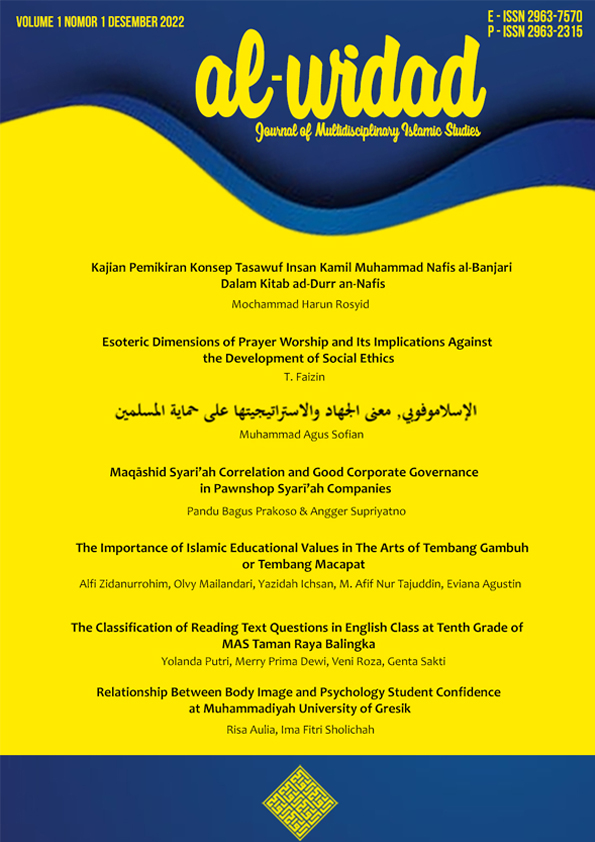
The Classification of Reading Text Questions in English Class at Tenth Grade of MAS Taman Raya Balingka
DOI:
https://doi.org/10.58405/aw.v1i2.4Keywords:
Class, Hots, ReadingAbstract
The research was triggered by several problems. First, Some sources book are not presenting HOTS model in several part of the book. Second, students have difficulty understanding questions in textbook. Third, The teacher does not provide teaching of Higher Order Thinking Skill (HOTS) while teaching process in order to maximize students higher order thinking skills. This research used quantitative research method. The subject was the questions in the textbook Bahasa Inggris X grade curriculum 2013 revisi 2017 written by Utami Widiati, Zuliati Rahmah, and Furaidah, which published Pusat Kurikulum dan Perbukuan, Balitbang, Kemendikbud. The researcher used items questions as the observation sheet of document for collecting and analyzing the data to find out the result of the research. This research found that the questions in the textbook did not include create of the cognitive process, based on bloom taxonomy revision. After doing analysis of the data, the researcher finds that the higher order thinking level only obtains 15 out of 74 items questions (20,25%). while the lower order thinking level 60 out of 74 items questions (79,20%). Results from this study show that the percentage of questions for each cognitive level is analyzing C4 (9,45%), evaluating C5 (6,75%), and creating C6(4,05%). This proportion does not meet the ideal proportion that supports the achievement of Basic Analysis Competence, the proportion questions that support are 30% for levels C1 and C2, 40% for levels C3 and C4, and 30% for levels C5 and C6.
Downloads
References
Anderson. (2003). Text Types in English. Macmilan Education Australia PTY.
Ardianto, E. (2016). Metodologi Penelitian untuk Public Relations Kuantitatif dan Kualitatif. In Simbiosa Rekatama Media.
Arikunto, S. (2010). Prosedur Penelitian Suatu Pendekatan Praktik. Rineka Cipta.
Assaly, I. R., & Smadi, O. M. (2015). Using bloom’s taxonomy to evaluate the cognitive levels of master class textbook’s questions. English Language Teaching, 8(5). https://doi.org/10.5539/elt.v8n5p100
Atiullah, K., Wuli Fitriati, S., & Rukmini, D. (2019). Using Revised Bloomâ€TMs Taxonomy to Evaluate Higher Order Thinking Skills (Hots) in Reading Comprehension Questions of English Textbook for Year X of High School. English Education Journal, 9(4). https://doi.org/10.15294/eej.v9i4.31794
Collingwood, D. (2015). Understanding and teaching reading comprehension. A handbook. Educational Psychology in Practice, 31(3). https://doi.org/10.1080/02667363.2015.1052233
Collins, E., & Stone, G. (2019). Motivations for textbook and learning resource publishing: Do academics want to publish oa textbooks? LIBER Quarterly, 29(1). https://doi.org/10.18352/lq.10266
Febrina, Usman, B., & Muslem, A. (2019). Analysis of Reading Comprehension Questions By Using Revised Bloom’s Taxonomy on Higher Order Thinking Skill (HOTS). English Education Journal, 10(1).
Ibnus, N. (2018). The Use of Deixis in Narrative Texts in the BSE English Textbook’s “Developing English Competencies 1.” PHILOSOPHICA Jurnal Bahasa, Sastra, Dan Budaya, 1(1). https://doi.org/10.35473/po.v1i1.115
Krathwohl, D. R. (2002). A revision of bloom’s taxonomy: An overview. In Theory into Practice (Vol. 41, Issue 4). https://doi.org/10.1207/s15430421tip4104_2
Limbach, B., & Waugh, W. (2010). Developing higher level thinking. Journal of Instructional Pedagogies.
Nafiati, D. A. (2021). Revisi taksonomi Bloom: Kognitif, afektif, dan psikomotorik. Humanika, 21(2). https://doi.org/10.21831/hum.v21i2.29252
Pasaribu, R. N., Tamba, E. E., & Saragih, E. (2021). ANALYSIS OF WRITING MATERIALS AND ACTIVITIES IN “ WHEN ENGLISH RINGS A BELL” IN TEXTBOOK. JISIP (Jurnal Ilmu Sosial Dan Pendidikan), 5(2). https://doi.org/10.36312/jisip.v5i2.1936
Pratiwi, N. W. (2021). Higher-Order Thinking Skills (HOTS) Based Reading Exercises in an EFL Textbook for the Second-Grade Students of Senior High School. U-Jet: Unila Journal of English Language Teaching, 10(4). https://doi.org/10.23960/UJET.v10.i4.202103
Putra, T. K., & Abdullah, D. F. (2019). HIGHER-ORDER THINKING SKILL (HOTS) QUESTIONS IN ENGLISH NATIONAL EXAMINATION IN INDONESIA. Jurnal Bahasa Lingua Scientia, 11(1). https://doi.org/10.21274/ls.2019.11.1.145-160
Sujatmiko, S. (2020). The Translation Problem Types in Translating Indonesia Text to English (A Case Study of Translation Subject of Fifth Semester English Students –UPY). ELTICS : Journal of English Language Teaching and English Linguistics, 4(1). https://doi.org/10.31316/eltics.v4i1.541
Wilson, G., Westphal, M., Hartmann, J., & Deuber, D. (2017). The use of question tags in different text types of Trinidadian English. World Englishes, 36(4). https://doi.org/10.1111/weng.12247
Downloads
Published
How to Cite
Issue
Section
License
Copyright (c) 2022 Al-Widad

This work is licensed under a Creative Commons Attribution-ShareAlike 4.0 International License.