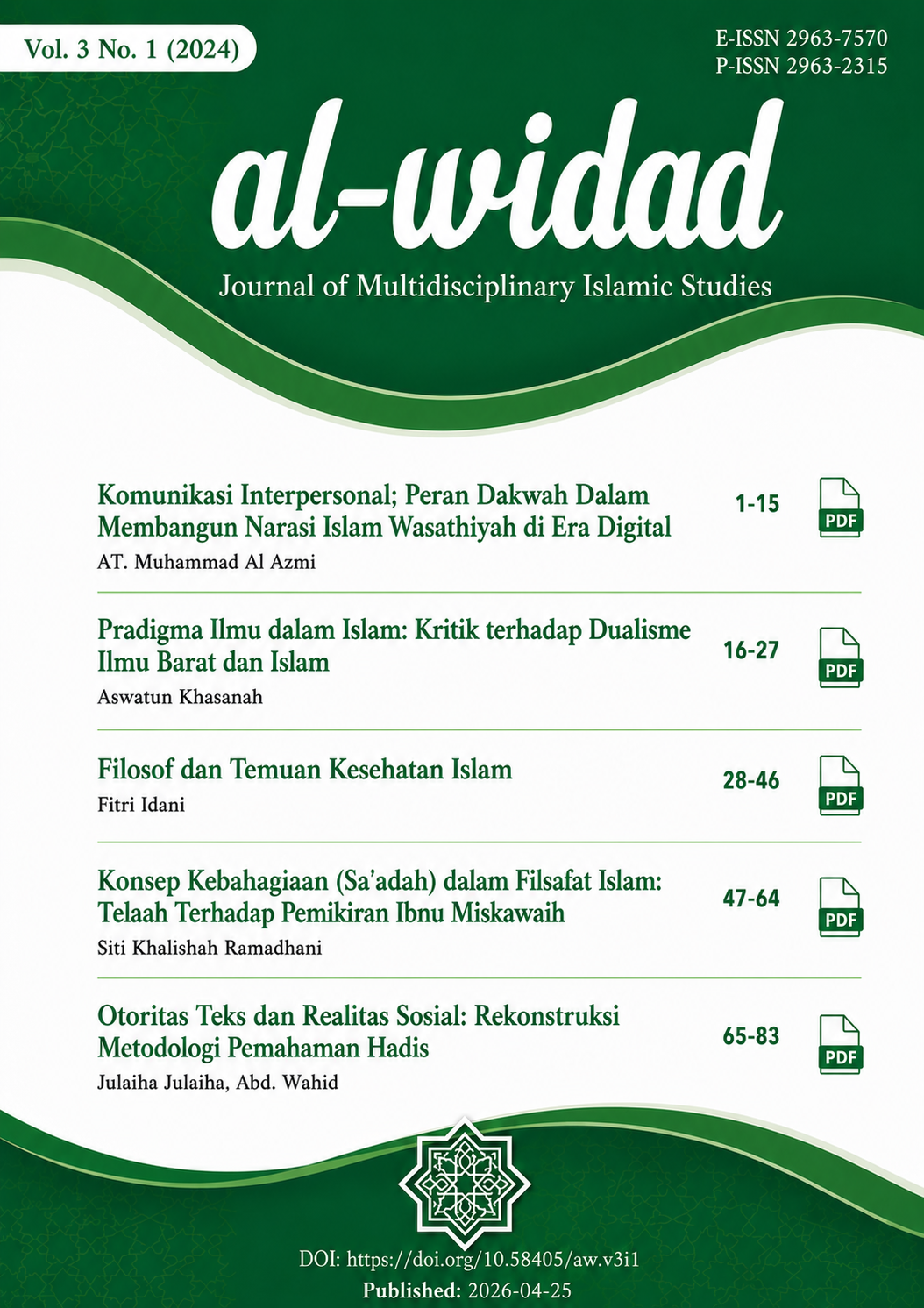
Konsep Kebahagiaan (Sa'adah) dalam Filsafat Islam: Telaah Terhadap Pemikiran Ibnu Miskawaih
DOI:
https://doi.org/10.58405/aw.v3i1.42Keywords:
Sa‘ādah, Ibn Miskawayh, Islamic PhilosophyAbstract
This study aims to analyze the concept of happiness (sa‘ādah) in Islamic philosophy according to Ibn Miskawayh and to examine its relevance in modern life. The study employs a qualitative approach using a library research method, relying on the analysis of Ibn Miskawayh’s works and various relevant scholarly sources. The data were analyzed through content analysis to identify and interpret the main ideas concerning happiness in his philosophical thought. The findings reveal that sa‘ādah, according to Ibn Miskawayh, is a state of spiritual perfection attained through the cultivation of reason, the development of virtuous character, and the control of human desires. Happiness is not merely oriented toward material aspects but also encompasses moral and spiritual dimensions that lead individuals toward the perfection of life. This concept remains relevant in addressing the tendency of modern society to define happiness in materialistic and individualistic terms.
Downloads
References
Alfarizi, Muhammad. “Konsep Kebahagiaan: Analisis Perbandingan Ibnu Miskawaih dan John Stuart Mill.” Paradigma: Jurnal Kalam dan Filsafat 5, no. 2 (2023). https://journal2.uinjkt.ac.id/index.php/paradigma/article/view/33712.
Aristotle. Nicomachean Ethics. Translated by W. D. Ross. Oxford: Oxford University Press, 2009.
Dewi, Ernita. “Akhlak dan Kebahagiaan Hidup Ibnu Miskawaih.” Substantia: Jurnal Ilmu-Ilmu Ushuluddin 21, no. 2 (2019): 115–126. https://jurnal.ar-raniry.ac.id/index.php/substantia/article/view/4829.
El-Yunusi, Muhammad Yusron Maulana. “Konsep Pendidikan Menurut Plato dan Ibnu Miskawaih.” El-Fikr: Jurnal Aqidah dan Filsafat Islam 6, no. 1 (2022). https://journal.radenfatah.ac.id/index.php/elfikr/article/view/12990.
Fakhry, Majid. Ethical Theories in Islam. Leiden: Brill, 1994.
Goodman, Lenn E. Islamic Humanism. Oxford: Oxford University Press, 2003.
Haque, Amber. “Psychology from Islamic Perspective: Contributions of Early Muslim Scholars and Challenges to Contemporary Muslim Psychologists.” Journal of Religion and Health 43, no. 4 (2004): 357–377.
Iqbal, Imam. “Konsep Kebahagiaan Menurut Ibn Miskawaih.” Tasamuh: Jurnal Studi Islam 13, no. 1 (2021). https://e-jurnal.iainsorong.ac.id/index.php/Tasamuh/article/view/211.
Leaman, Oliver. An Introduction to Classical Islamic Philosophy. Cambridge: Cambridge University Press, 2002.
Miskawayh, Ibn. Tahdhib al-Akhlaq wa Tathir al-A‘raq. Beirut: Dar al-Kutub al-‘Ilmiyyah, 1985.
Miskawayh, Ibn. The Refinement of Character. Translated by Constantine K. Zurayk. Beirut: American University of Beirut Press, 1968.
Nasr, Seyyed Hossein. Islamic Philosophy from Its Origin to the Present. Albany: State University of New York Press, 2006.
Rahman, Fazlur. Major Themes of the Qur’an. Chicago: University of Chicago Press, 2009.
Sharif, M. M., ed. A History of Muslim Philosophy. Wiesbaden: Otto Harrassowitz, 1963.
Subiyakto, Sentot Heru. “Konsep Kebahagiaan (Sa‘adah) dalam Filsafat Etika Islam.” Jurnal Zaka 1, no. 2 (2023). https://oj.mjukn.org/index.php/jz/article/view/3923.
Umaruddin. The Ethical Philosophy of Ibn Miskawayh. Aligarh: Aligarh Muslim University Press, 1970.
Yusuf, M. Yunan. Alam Pikiran Islam Pemikiran Kalam dari Khawarij ke Buya Hamka. Jakarta: Kencana, 2014.
Al-Attas, Syed Muhammad Naquib. Islam and Secularism. Kuala Lumpur: ISTAC, 1993.
Al-Ghazali. Ihya’ ‘Ulum al-Din. Beirut: Dar al-Ma‘rifah, n.d.
Wolfson, Harry Austryn. The Philosophy of the Kalam. Cambridge, MA: Harvard University Press, 1976.
Downloads
Published
How to Cite
Issue
Section
License
Copyright (c) 2026 Al-Widad

This work is licensed under a Creative Commons Attribution-ShareAlike 4.0 International License.