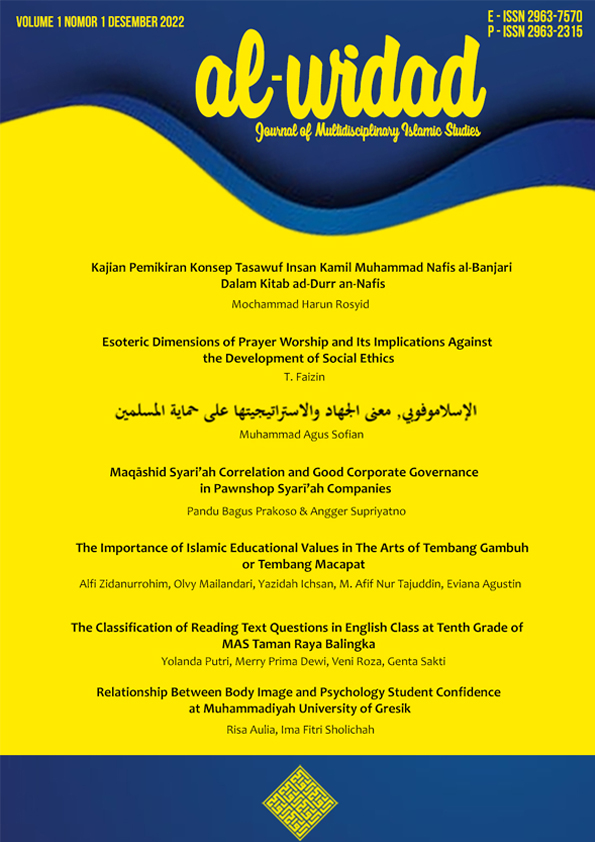
الإسلاموفوبي، معنى الجهاد و الاستراتيجيتها على حماية المسلمين
DOI:
https://doi.org/10.58405/aw.v1i1.5Keywords:
Islamophobia, Islamic, JihadAbstract
This writing aims to explain Islamophobes and protect Muslims over the people in the world, becoming Islamophobes not transforming the model and goals of Islam itself. Then get it from people in the world who hate and fear Islam and yet most Western politicians deal with this phenomenon. This study also supports the theory of scholars and thinkers on Islamophobia and its protection from Muslims and how to deal with it. This study uses a qualitative method, which is research with desk research models. The primary sources that the researcher used are the Quranic verses about the true meaning of the word "jihad", and he matches them with the paper of Western thinkers. Islamophobia has become a general disease and a societal phenomenon, most of which is Islam, and it is not appropriate to ignore or forget it as a station in the history of Islam during the era of our Prophet Muhammad, peace be upon him. Then what about the concept and how to treat it? This research will try to answer and discuss it.
Downloads
References
Al-Mahalli, J., & Al-Suyuti, J. (1994). Tafsir Jalalain. Daar Ibn Katsir.
Apriliani, D. R., & Rosyad, R. (2021). Islamophobia in Indonesia. Gunung Djati Conference Series, Volume 4 (2021) Proceedings The 1st Conference on Ushuluddin Studies ISSN: 2774-6585, 4.
Bazian, H. (2018). Islamophobia, “Clash of civilizations”, and forging a post-cold war order! Religions, 9(9). https://doi.org/10.3390/rel9090282
Dauda, K. O. (2021). Islamophobia and religious intolerance: Threats to global peace and harmonious co-existence. Qudus International Journal of Islamic Studies, 8(2). https://doi.org/10.21043/qijis.v8i2.6811
Husain, S. C. (2020). Muslim community organizations’ perceptions of islamophobia: Towards an informed countering response. Religions, 11(10). https://doi.org/10.3390/rel11100485
Ibnu Mandzur. (2005). Lisan al-Arab. Daar al-Fikr.
Katsir, I. I. U. I. (2006). Tafsir Ibnu Katsir (Juz VI). Darul Kutub Ilmiyah.
Khalid, A. S. (2018). METODOLOGI TAFSIR FAKHRU AL-DIN AL-RAZI: Telaah Tafsir QS. Al-Fatihah dalam Mafatih al-Ghayb. Al - Tadabbur: Jurnal Ilmu Al-Qur’an Dan Tafsir, 3(01). https://doi.org/10.30868/at.v3i01.257
Mahasneh, A. A. (2021). The translation of jihad verses after the emergence of ISIS: Distortion or reality. Academic Journal of Interdisciplinary Studies, 10(5). https://doi.org/10.36941/ajis-2021-0128
Makhfud, M. (2017). URGENSI TAFSIR MAUDHU`I (KAJIAN METODOLOGIS). Jurnal Pemikiran Keislaman, 27(1). https://doi.org/10.33367/tribakti.v27i1.256
Mohammad Haziq Mohd Isnin, & Abdul Hafiz Abdullah. (2021). Pengajian Tafsir Al-Quran Di Masjid Negeri Johor Dalam Membentuk Peribadi Umat Islam. Journal of Fatwa Management and Research, 26(2). https://doi.org/10.33102/jfatwa.vol26no2.425
Najib, K., & Teeple Hopkins, C. (2020). Geographies of Islamophobia. In Social and Cultural Geography (Vol. 21, Issue 4). https://doi.org/10.1080/14649365.2019.1705993
Sealy, T. (2021). Islamophobia: With or without islam? Religions, 12(6). https://doi.org/10.3390/rel12060369
Shihab, Q. (2018). Islam yang Saya Anut. In Annual International Conference on Islamic Studies (Vol. 12, Issue january).
Wildan, T., & Nasution, I. F. A. (2022). JALÂL AL-DÎN AL-MAHALLÎ AND JALÂL AL-DÎN AL-SUYUTÎS’ INTERPRETATION METHOD OF THE MUTASYÂBIHÂT VERSE IN TAFSÎR JALÂLAYN. MIQOT: Jurnal Ilmu-Ilmu Keislaman, 46(1). https://doi.org/10.30821/miqot.v46i1.882
Downloads
Published
How to Cite
Issue
Section
License
Copyright (c) 2022 Al-Widad

This work is licensed under a Creative Commons Attribution-ShareAlike 4.0 International License.