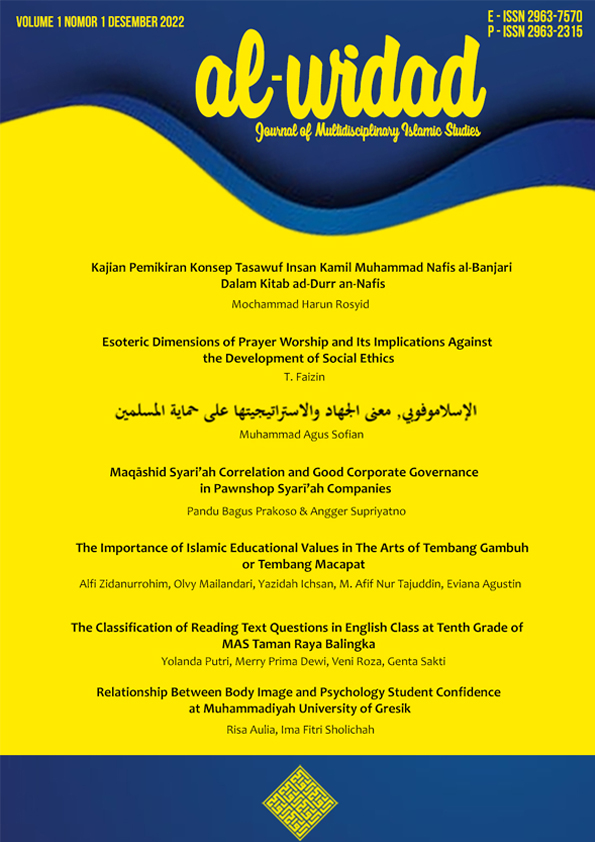
Kajian Pemikiran Konsep Tasawuf Insan Kamil Muhammad Nafis al-Banjari Dalam Kitab ad-Durr an-Nafis
DOI:
https://doi.org/10.58405/aw.v1i1.8Keywords:
insan kamil, Islamic thought, sufismAbstract
The study of the concept of insan kamil (the perfect man) is a study that is very often discussed in Sufism. The concept of insan kamil that emerged in the world of Sufism in the VII H century eventually developed in Islamic thought to the Archipelago. Because many discoveries from the books written by the Sufis. There is some evidence of Sufis who study this theme, namely Muhammad Nafis al-Banjari in his book ad-Durr an-Nafis and Abd al-Karim al-Jili in his book al-Insan al-Kamil fi Ma’rifat al-Awakhir wa al-Awa' il. Muhammad Nafis al-Banjari was not the first originator of the concept of insan kamil because several scholars have discussed the concept of insan kamil such as Ibn ‘Arabi, al-Hallaj, al-Suhrawardi, at-Tirmidhi. The book of ad-Durr an-Nafis has clarity and ways in the formation of human beings with religious values. Insan kamil can be formed if humans respect each other and carry out their religious teachings purely and consistently. This paper aims to explain and provide a good understanding of the concept of insan kamil from the book ad-Durr an-Nafis.
Downloads
References
’Arabi, I. (1995). Fushush al-Hikam. Daar al-Fikr.
Abd Rasyid, N. (2020). THE CONCEPT OF AL-WIHDATUL WUJUD IBNU ARABI (A Sufistic Philosophical Study). HUNAFA: Jurnal Studia Islamika, 17(1). https://doi.org/10.24239/jsi.v17i1.582.68-83
Akhir, N. S. M. (2011). Pengaruh Syeikh Muhammad Nafis al-Banjari di Kalimantan Selatan. In Prosiding Nadwah Ulama Nusantara (NUN) IV: Ulama Pemacu Transformasi Negara (Issue November).
Al-Ghazali, A. H. (1983). Al-Iqtishad fi Al-I’tiqad. Daar al-Kitab al-Arabi.
Al-Qusyairi, A. al-K. (1999). Al-Risalah al-Qusyairiyyah fi Ilm al-Tashawwuf. Daar al-Ma’arif.
Albi, A., & Setiawan, J. (2018). Metodologi Penelitian Kualitatif. CV Jejak.
Azra, A. (1994). Jaringan Ulama Timur Tengah dan Kepulauan Nusantara abad XVII dan XVIII : Melacak Akar-Akar Pembaruan Pemikiran Islam di Indonesia. Mizan.
Belo, C. (2006). Averroes on God’s Knowledge of Particulars. Journal of Islamic Studies, 17(2), 177–199. https://doi.org/10.1093/jis/etl022
Bindaniji, M. (2020). Traces of Māturīdīsm in the ‘Ulamā’s Works in Nusantara in the Seventeenth Until Nineteenth Centuries. ISLAM NUSANTARA: Journal for Study of Islamic History and Culture, 1(1). https://doi.org/10.47776/islamnusantara.v1i1.50
Budiyanti, N., Aziz, A. A., Palah, & Mansyur, A. S. (2020). the Formulation of the Goal of Insan Kamil as a Basis for the Development of Islamic Education Curriculum. IJECA (International Journal of Education and Curriculum Application), 3(2).
Danarta, A. (2021). PATTERN OF SUFISTIC HADITH IN THE CONCEPT OF INSAN KAMIL ABD AL-KARIM AL-JILI. Jurnal Studi Ilmu-Ilmu Al-Qur’an Dan Hadis, 22(1). https://doi.org/10.14421/qh.2021.2201-08
Hakiki, K. M. (2018). Insan Kamil dalam Perspektif Syaikh Abd al-Karim al-Jili. Wawasan: Jurnal Ilmiah Agama Dan Sosial Budaya, 3(2), 175–186. https://doi.org/10.15575/jw.v3i2.2287
Irawan, B., Nasution, I. F. A., & Coleman, H. (2021). Applying Ibn ʿArabī’s Concept of Tajallī: A Sufi Approach to Environmental Ethics. Teosofia: Indonesian Journal of Islamic Mysticism, 10(1). https://doi.org/10.21580/tos.v10i1.7204
Khulaisie, R. N. (2016). Hakikat Kepribadian Muslim , Seri Pemahaman Jiwa Terhadap Konsep Insan Kamil. Jurnal Refletika, 11(11), 39–57.
Kolis, N. (2020). KONSTRUKSI PEMIKIRAN TASAWUF WUJUDIYAH DALAM NASKAH AMBULUNG DI KALIMANTAN SELATAN. Al-A’raf : Jurnal Pemikiran Islam Dan Filsafat, 17(1). https://doi.org/10.22515/ajpif.v17i1.1956
Lala, I. (2021). Qur’ānic Knowledge and Akbarian Wisdom: Ibn ‘Arabī‘s Daring Hermeneutics in Fuṣūṣ al-ḥikam. Cumhuriyet Ilahiyat Dergisi, 25(1). https://doi.org/10.18505/cuid.851857
Moleong, L. J. (2009). Metodologi Penelitian Kualitatif. PT. Remaja Rosda Karya.
Moleong, L. J. (2018). Metodologi Penelitian Kualitatif, cet. In XI. Bandung: PT Remaja Rosdakarya.
Nafis, Syekh Muhammad. (2011). Al-Durr al-Nafis. Pustaka Lentera.
Noor Syahidah, M. A. (2014). Karya Utama Syeikh Muhammad Nafis Al-Banjari: Analisa Teks Manuskrip Al-Durr Al-Nafis (MSS 225). International Journal of the Malay World and Civilisation (Iman), 2(1).
Rifa’i. (2016). Internalisasi Nilai-nilai Religius Berbasis Multikultural. Jurnal Pendidikan Agama Islam, 4, 116–133.
Rodiah, R. (2015). Insan Kamil Dalam Pemikiran Muhammad Nafis Al-Banjari Dan Abdush-Shamad Al-Falimbânî Dalam Kitab Ad-Durr an-Nafis Dan Siyar As-Sâlikîn (Sebuah Studi Perbandingan). Jurnal Studia Insania, 3(2), 97. https://doi.org/10.18592/jsi.v3i2.1118
Salvaggio, F. (2021). Polysemy as hermeneutic key in Ibn ’Arabī’s Fuṣūṣ al-Ḥikam. Annali Di Ca Foscari Serie Orientale, 1. https://doi.org/10.30687/ANNOR/2385-3042/2021/01/003
Sani, M. (2015). TARIKAT SUFIYAH ISLAM DALAM PEMIKIRAN TASAWUF H. ABDUL MUIN HIDAYATULLAH. Al-Banjari : Jurnal Ilmiah Ilmu-Ilmu Keislaman, 12(2). https://doi.org/10.18592/al-banjari.v12i2.447
Seleznyov, N. (2020). Devatasutra in the Arabic compendium of chronicles of Rashid al-din. In Gosudarstvo, Religiia, Tserkov’ v Rossii i za Rubezhom/State, Religion and Church in Russia and Worldwide (Vol. 38, Issue 3). https://doi.org/10.22394/2073-7203-2020-38-3-237-254
Sugianto, S. (2020). Toleransi Beragama Perspektif Wahdat Al-Wujūd Ibnu Arabi. Indonesian Journal of Islamic Theology and Philosophy, 1(2). https://doi.org/10.24042/ijitp.v1i2.5076
Sumanta. (2021). The Values of Perfect Human Beings in the Dignity Seven of Insān Kāmil. Journal of Social Studies Education Research, 12(4).
Susanto, H. (2014). Filsafat Manusia Ibnu Arabi. TSAQAFAH, 10(1). https://doi.org/10.21111/tsaqafah.v10i1.66
Tim Sahabat. (2010). 27 Ulama Berpengaruh Kalimantan Selatan (Sahabat Pr).
Wildan, T. (2022). The Contribution of Majelis Taklim Tastafi in Shaping the Spiritual Dimension of Langsa City Community. Hayula: Indonesian Journal of Multidisciplinary Islamic Studies, 6(2), 205–226. https://doi.org/10.21009/hayula.006.02.04
Wildan, T., & Nasution, I. F. A. (2022). JALÂL AL-DÎN AL-MAHALLÎ AND JALÂL AL-DÎN AL-SUYUTÎS’ INTERPRETATION METHOD OF THE MUTASYÂBIHÂT VERSE IN TAFSÎR JALÂLAYN. MIQOT: Jurnal Ilmu-Ilmu Keislaman, 46(1). https://doi.org/10.30821/miqot.v46i1.882
Wu, K. (1986). Sufism and Taoism: A Comparative Study of Key Philosophical Concepts . Toshihiko Izutsu . The Journal of Religion, 66(3). https://doi.org/10.1086/487422
Zakaria, S. (2001). Insanl Kamil: CIRI DAN PROSES PEMBENTUKAN. Afkar, 2(2), 43–60.
Zarkasyi, M. (2019). Dakwah Tauhid Muhammad Nafis al-Banjari (1150 H/1735 M). Tsaqafah, 15(1), 155. https://doi.org/10.21111/tsaqafah.v15i1.2978
Downloads
Published
How to Cite
Issue
Section
License
Copyright (c) 2022 Al-Widad

This work is licensed under a Creative Commons Attribution-ShareAlike 4.0 International License.